1968 marks the beginning of the ‘You’ve Come a Long Way, Baby’ Campaign.
The campaign created by the Leo Burnett agency, was created to advertise British tobacconist Phillip Morris’s new brand of cigarettes, ‘Virginia Slims’. A brand of ‘slim’ cigarettes which were marketed to women as a new way to defy gender norms during a time of women’s liberation and second wave feminism. This particular image is the first in a series of advertisements with the slogan ‘You’ve Come a Long Way’.
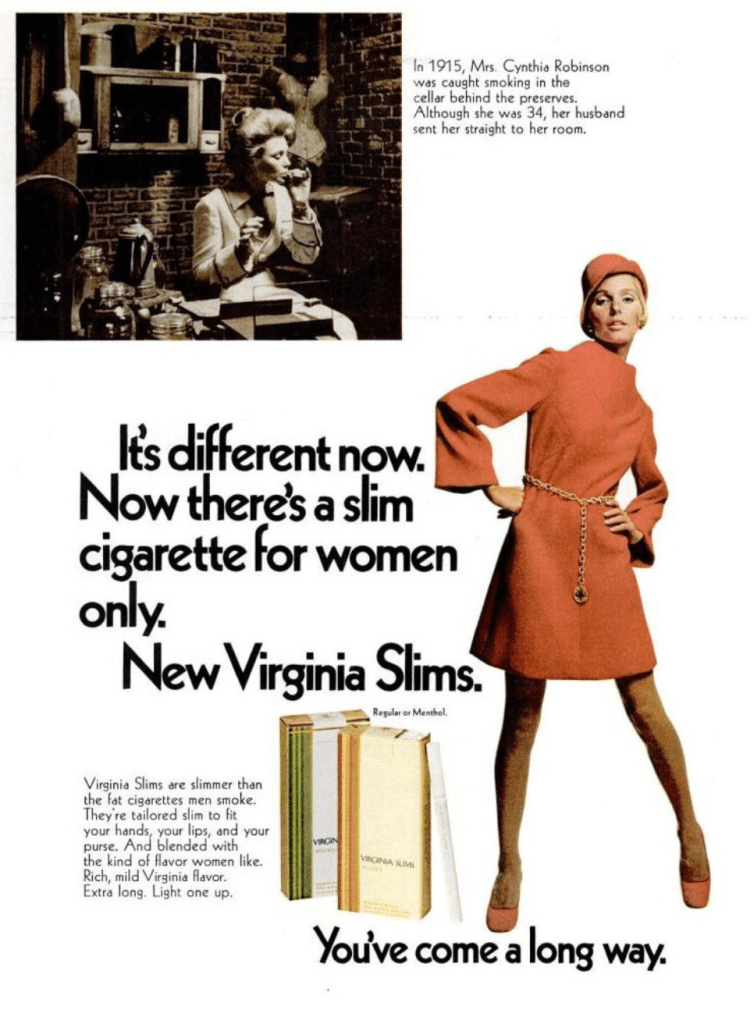
(First Advert for ‘Virginia Slims’)
As viewers of this image, we may analyse it using semiotics, the science of signs and symbols. As Daniel Chandler (2021) writes, in his book ‘Semiotics for Beginners’, “In semiotics, denotation and connotation are terms describing the relationship between the signifier and its signified”, the signifier being what you are interpreting and the signified being how you interpret it.
In semiotics terms, at first glance, the signifiers or denotations in this image are the 2 separate depictions of women, the box of ‘slim’ cigarettes as well as various blocks of text. On the left is an image in sepia of a woman smoking a cigarette. The small block of text beside the image informs us that this woman smoking a cigarette was then ‘sent straight to her room’ by her husband. The image on the right is quite a contrast from this. It’s eye-catching and vibrant and depicts a confident looking woman, posing in a ‘stylish’ outfit. Next to her, a packet of ‘Virginia Slims’. The packet appears sleek and the cigarette is slim and dainty. Above the packet a large and bold block of text lets us know that there is ‘now a slim cigarette for women only’.
As viewers, a connotation we may make from this image is that the woman on the left represents the past. The picture of her appears dull and ‘old’ as the sepia colour can be associated with the past. We may interpret the image on the right to represent ‘a new kind of woman’. She’s proud, stylish and confident and defies traditional gender norms in a fashionable orange dress which sits above her knees.
As individuals, the ways in which we interpret the world around us is going to be vastly different. For example, a connotation a viewer might make from this image is that these cigarettes are intended for a certain kind of woman. A skinny or ‘slim’ woman.

(British Fashion model Lesley Lawson)
The 1960’s also marks a shift of the beauty standard in which women were now ideally thin. This new ideal was popularised by fashion models at the time. In particular British fashion model Lesley Lawson, ‘Twiggy’ who was young and skinny. The representation of the ‘new woman’ on the right of the advert who smokes ‘Virginia Slims’ is slim herself.
Therefore, whilst this advert may appeal to some women by turning cigarettes into a symbol of feminism and liberation, others may be put off by it and instead believe that the branding intentionally promotes an unrealistic beauty standard.
Bibliography
Howard, J 2018, Edition CNN, Cable News Network, viewed 1 April 2026,
Chandler, 2021, Semiotics for Beginners, Routledge, viewed 1 April 2026,
< http://visual-memory.co.uk/daniel/Documents/S4B/sem06.html >
Image, Women’s Weekly, viewed 1 April 2026, <https://www.womensweekly.com.au/news/twiggy-documentary/ >
Image, Flashbak, viewed 1 April 2026,<https://flashbak.com/youve-come-a-long-way-baby-virginia-slims-advertising-year-by-year-365664/>
Lowbrow, Y 2016, Flashbak, Alum Media, viewed 1 April 2026,<https://flashbak.com/youve-come-a-long-way-baby-virginia-slims-advertising-year-by-year-365664/>
 Frida Blog BCM 110
Leave a comment